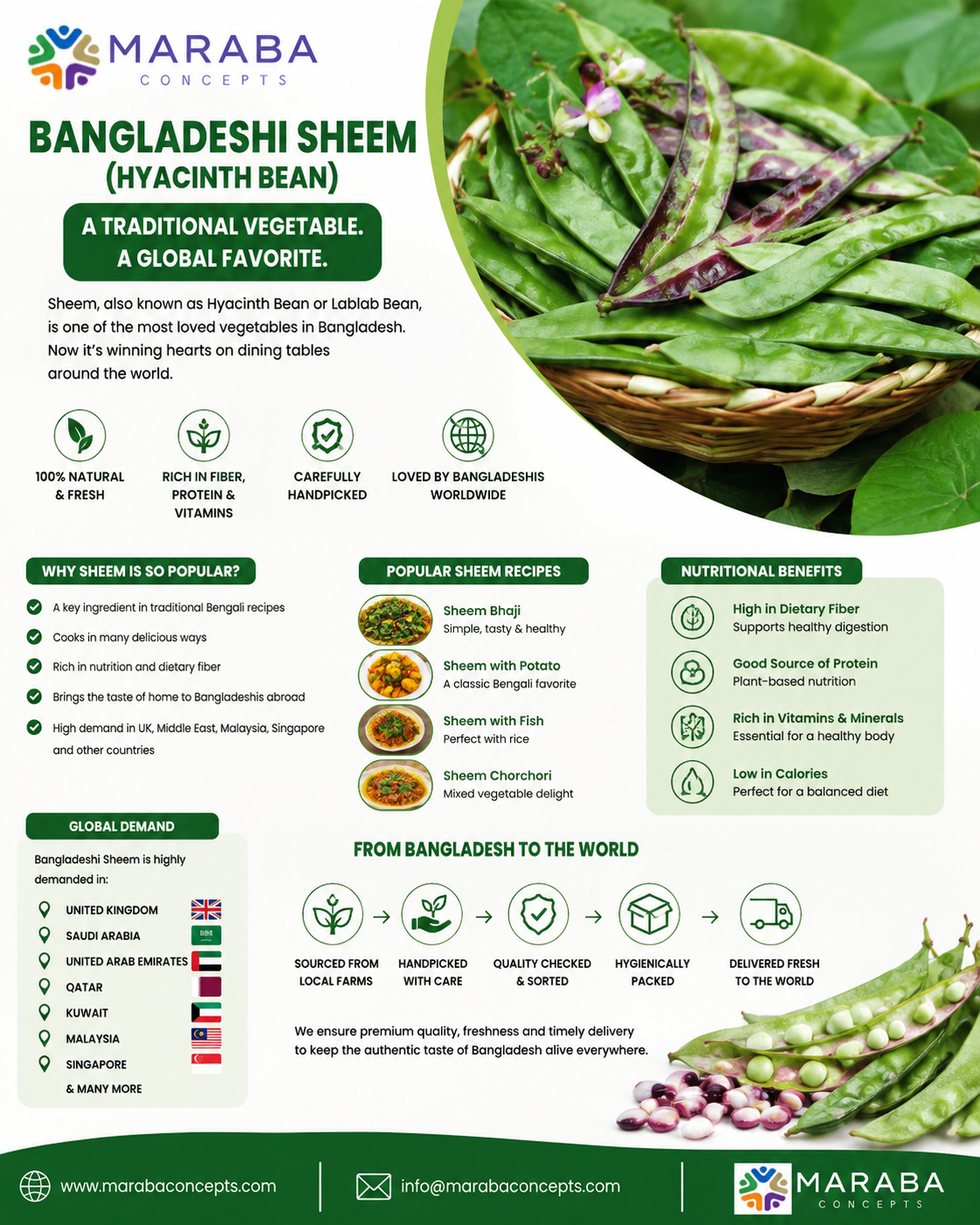
Bangladeshi Sheem: Why This Traditional Vegetable Is So Loved by Bangladeshis Around the World
Bangladeshi Sheem is much more than an ordinary vegetable.
Known internationally as Hyacinth Bean, Lablab Bean, Country Bean, or Indian Bean, Sheem is one of the most familiar vegetables in Bangladeshi households. From traditional Bengali kitchens in Bangladesh to Bangladeshi grocery stores in London, Riyadh, Dubai, Kuala Lumpur, and Singapore, Sheem continues to hold a special place in the food culture of Bangladeshis living abroad.
But why do Bangladeshis living overseas look for Sheem?
Why does a simple vegetable create such a strong connection with home?
The answer goes beyond taste.
Bangladeshi Sheem represents food, culture, family memories, traditional cooking, and a connection to Bangladesh.
What Is Sheem?
Sheem is the common Bangladeshi name for a type of legume vegetable. Its scientific name is Lablab purpureus, and it is widely known internationally as Hyacinth Bean or Lablab Bean.
The young green pods are commonly cooked as vegetables, while the mature seeds can also be used in different food preparations.
In Bangladesh, Sheem is traditionally associated with home-style cooking and is widely used in a variety of Bengali recipes.
Why Is Bangladeshi Sheem So Popular?
There are several reasons why Sheem remains a favorite vegetable among Bangladeshis.
1. It is part of traditional Bengali cuisine
Sheem has been a familiar ingredient in Bangladeshi kitchens for generations.
It can be cooked in many ways, including:
- Sheem Bhaji — stir-fried Sheem
- Sheem with potatoes
- Sheem with eggplant
- Sheem Chorchori
- Sheem with fish
- Mixed vegetable curry with Sheem
- Sheem with lentils
- Sheem and other seasonal vegetables
This versatility makes it a natural part of everyday Bengali cooking.
Why Do Bangladeshis Miss Sheem When Living Abroad?
The answer is strongly connected to food nostalgia.
For many Bangladeshis living in the UK, Saudi Arabia, UAE, Qatar, Kuwait, Malaysia, Singapore, and other countries, food is one of the strongest connections to their homeland.
Imagine a Bangladeshi living in London finding fresh Sheem at a local Asian grocery store.
Or a Bangladeshi family in Riyadh preparing Sheem and potatoes with rice.
Or someone living in Kuala Lumpur cooking traditional Sheem Bhaji after a long working day.
The vegetable may look simple.
But the memories attached to it are not.
Sheem can remind people of home, parents, childhood, family meals, village life, winter mornings, and traditional Bengali cooking.
That emotional connection is one reason traditional Bangladeshi vegetables remain relevant in international ethnic food markets.
Bangladeshi Sheem in the UK
The United Kingdom has a large Bangladeshi and South Asian community, creating a strong market for traditional ethnic foods and vegetables.
For Bangladeshi consumers in London and other UK cities, vegetables such as Sheem are not simply alternative vegetables.
They are ingredients for familiar recipes.
Consumers may search online for:
- Bangladeshi Sheem UK
- Fresh Sheem in London
- Bangladeshi vegetables UK
- Hyacinth Bean UK
- Lablab Bean UK
- Fresh Bangladeshi vegetables
- Deshi vegetables in UK
This creates an opportunity for suppliers and exporters who can provide consistent quality and reliable fresh-produce supply.
Bangladeshi Sheem in Saudi Arabia and the Middle East
Saudi Arabia and the wider Gulf region are important destinations for Bangladeshi communities.
Cities such as Riyadh, Jeddah, Dammam, Makkah, and Madinah have diverse South Asian communities and ethnic food markets.
For Bangladeshi consumers, finding familiar vegetables such as Sheem can make traditional home cooking easier.
A simple meal of:
Rice + Dal + Sheem Bhaji
can bring back the taste of Bangladesh.
The same applies to Bangladeshi communities in:
- 🇸🇦 Saudi Arabia
- 🇦🇪 United Arab Emirates
- 🇶🇦 Qatar
- 🇰🇼 Kuwait
- 🇴🇲 Oman
- 🇧🇭 Bahrain
The demand for ethnic vegetables is closely connected to the presence of diaspora communities and their traditional food habits.
Sheem in Malaysia and Singapore
Malaysia and Singapore are also important destinations for South Asian and Bangladeshi communities.
Bangladeshis living and working in these countries often look for vegetables that are familiar from home.
This includes traditional vegetables such as:
Sheem, Pottol, Korola, Lau, Loti, Kachu, green chili, and other Bangladeshi vegetables.
For these consumers, local supermarket vegetables may not always provide the same ingredients needed for traditional Bengali recipes.
That is where ethnic fresh-produce supply becomes important.
What Is Sheem Called in English?
If you are searching for Bangladeshi Sheem internationally, you may find several different names.
Common names include:
- Sheem
- Bangladeshi Sheem
- Hyacinth Bean
- Lablab Bean
- Country Bean
- Indian Bean
- Bengali Bean
The terminology can vary by country, retailer, and market.
This is particularly important for international buyers because someone searching for “Hyacinth Bean” may be looking for the same type of vegetable that a Bangladeshi consumer calls “Sheem.”
How Is Sheem Used in Bengali Cooking?
One of the reasons Sheem remains popular is its versatility.
Sheem Bhaji
Simple stir-fried Sheem is one of the easiest ways to enjoy this vegetable.
Sheem and Potato Curry
Sheem combined with potatoes creates a familiar Bangladeshi home-style dish.
Sheem Chorchori
A traditional Bengali-style mixed vegetable preparation where Sheem can be combined with other seasonal vegetables.
Sheem with Fish
Sheem can also be cooked with different types of fish, creating a distinctly Bengali combination.
Sheem with Lentils
Sheem can be incorporated into lentil-based dishes and mixed vegetable preparations.
This wide range of recipes helps explain why Sheem continues to be a household favorite.
Is Sheem a Nutritious Vegetable?
Sheem is a legume vegetable and can contribute nutrients such as dietary fiber, protein, vitamins, and minerals to the diet.
The nutritional composition can vary depending on the variety and maturity of the pods.
As with other vegetables, Sheem can be part of a balanced and varied diet.
Its nutritional value, however, should not be interpreted as a claim that it treats or prevents specific diseases.
Why Is Bangladeshi Sheem Different for Overseas Bangladeshis?
The strongest difference may not be botanical.
It is cultural.
For a Bangladeshi consumer living abroad, Sheem can represent:
Taste + Tradition + Memory + Identity
That is why the demand for Bangladeshi vegetables cannot always be explained purely by price or nutritional value.
There is also a powerful cultural food connection.
A Bangladeshi grocery store selling fresh Sheem is, in a small way, bringing a familiar part of Bangladesh to another country.
From Bangladesh to the World: The Export Opportunity
Bangladesh has a diverse agricultural sector capable of producing many vegetables that are highly familiar to South Asian consumers.
The international market opportunity is particularly interesting where large Bangladeshi and South Asian diaspora communities live.
Potential markets include:
United Kingdom
A major destination for Bangladeshi and South Asian ethnic food products.
Saudi Arabia
A large Gulf market with a substantial South Asian consumer base.
United Arab Emirates
A highly diverse food market with strong demand for international and ethnic produce.
Qatar and Kuwait
Important Gulf destinations for South Asian communities.
Malaysia
A significant destination for Bangladeshi workers and consumers.
Singapore
A sophisticated international food market with established Asian and South Asian consumer segments.
However, successful fresh vegetable exports require much more than simply producing the crop.
Exporters need to consider:
Quality → Sorting → Grading → Packaging → Food Safety → Cold Chain → Phytosanitary Compliance → Logistics → Market Distribution
These factors are critical for maintaining freshness and building trust with international buyers.
Why Bangladeshi Sheem Has Global Potential
The story of Sheem demonstrates something bigger about Bangladesh's agricultural products.
A vegetable produced by a Bangladeshi farmer can potentially travel thousands of kilometers and reach a Bangladeshi family living in another country.
The customer is not necessarily buying only a vegetable.
They may be buying the ability to prepare:
the food they grew up eating.
That creates an important opportunity for Bangladesh-origin fresh produce in international ethnic food markets.
What Are People Searching for Online?
Consumers and buyers may use different search terms for the same product.
Bangladeshi Sheem Keywords
- Bangladeshi Sheem
- Sheem vegetable
- Deshi Sheem
- Fresh Sheem
- Bangladesh Sheem
- Sheem vegetable Bangladesh
English Keywords
- Hyacinth Bean
- Lablab Bean
- Country Bean
- Indian Bean
- Fresh Hyacinth Bean
- Fresh Lablab Bean
- Bangladeshi Hyacinth Bean
International Buyer Keywords
- Bangladeshi vegetables
- Fresh vegetables from Bangladesh
- Bangladesh vegetable exporter
- Bangladeshi vegetable supplier
- Fresh Bangladeshi vegetables
- Bangladesh fresh produce exporter
- Bangladeshi ethnic vegetables
Diaspora-focused Search Keywords
- Bangladeshi vegetables UK
- Bangladeshi Sheem UK
- Fresh Sheem London
- Bangladeshi vegetables Saudi Arabia
- Bangladeshi vegetables in Riyadh
- Bangladeshi vegetables UAE
- Bangladeshi vegetables Qatar
- Bangladeshi vegetables Malaysia
- Bangladeshi vegetables Singapore
How Can AI Search Understand Bangladeshi Sheem?
Modern search is increasingly conversational.
People no longer search only for short keywords.
They ask complete questions such as:
“What is Sheem called in English?”
“What is Hyacinth Bean?”
“Why is Sheem popular among Bangladeshis?”
“Where can I find Bangladeshi vegetables in the UK?”
“Which Bangladeshi vegetables are exported overseas?”
“What vegetables are popular among Bangladeshis living in Saudi Arabia?”
For this reason, high-quality content should answer both keyword-based searches and natural-language questions.
A well-structured article should clearly connect the different concepts:
Sheem → Hyacinth Bean → Lablab Bean → Bangladeshi Vegetable → Bengali Cuisine → Bangladeshi Diaspora → Ethnic Food Market → Fresh Vegetable Export
This helps create a strong topical relationship around the subject rather than simply repeating a keyword.
Maraba Concepts: Connecting Bangladesh's Produce with Global Markets
Maraba Concepts focuses on connecting Bangladesh-origin agricultural products with international markets.
Our vision is simple:
Bangladesh → Quality Produce → Global Markets
We are interested in creating international opportunities for Bangladeshi fruits, vegetables, frozen vegetables, and other agricultural products.
For buyers looking for Bangladeshi fresh vegetables, ethnic vegetables, Bangladesh-origin produce, or agricultural sourcing opportunities, Maraba Concepts aims to build reliable connections between producers, suppliers, and international markets.
Website: www.marabaconcepts.com
Email: info@marabaconcepts.com
Frequently Asked Questions About Bangladeshi Sheem
What is Sheem called in English?
Sheem is commonly known internationally as Hyacinth Bean or Lablab Bean. It may also be called Country Bean or Indian Bean.
Is Sheem a popular vegetable in Bangladesh?
Yes. Sheem is a familiar and widely used vegetable in Bangladeshi and Bengali home cooking.
Why do Bangladeshis living abroad like Sheem?
Because of its familiar taste, traditional recipes, cultural connection, and the memories associated with Bangladeshi home cooking.
Where is Bangladeshi Sheem popular?
Bangladeshi Sheem is particularly relevant to ethnic food markets serving Bangladeshi and South Asian communities in countries such as the UK, Saudi Arabia, UAE, Qatar, Kuwait, Malaysia, and Singapore.
Can Sheem be exported from Bangladesh?
Bangladesh exports various fresh vegetables to international markets. For fresh Sheem and other vegetables, successful export requires appropriate quality control, packaging, food-safety procedures, phytosanitary compliance, cold-chain management, and logistics.
What is Lablab Bean?
Lablab Bean is another English name commonly used for the plant species associated with Sheem, Lablab purpureus.
Final Thought: More Than a Vegetable
Sheem may look like an ordinary vegetable.
For millions of Bangladeshis, however, it represents something much more.
It represents:
Home.
Family.
Tradition.
Bengali cooking.
Childhood memories.
And the taste of Bangladesh.
That is why a simple plate of Sheem Bhaji can mean so much to a Bangladeshi living thousands of kilometers away from home.
From Bangladesh's farms to international ethnic food markets, Bangladeshi Sheem has a story worth sharing with the world.
Maraba Concepts
Bringing the Taste of Bangladesh to Global Markets.